Data Observability
What the 2026 Gartner® Market Guide for Data Observability Tools Really Says About AI-Ready Data.

Team Qualdo
30 Mar 2026
Qualdo Recognized in the Gartner® Market Guide for Data Observability Tools 2026.
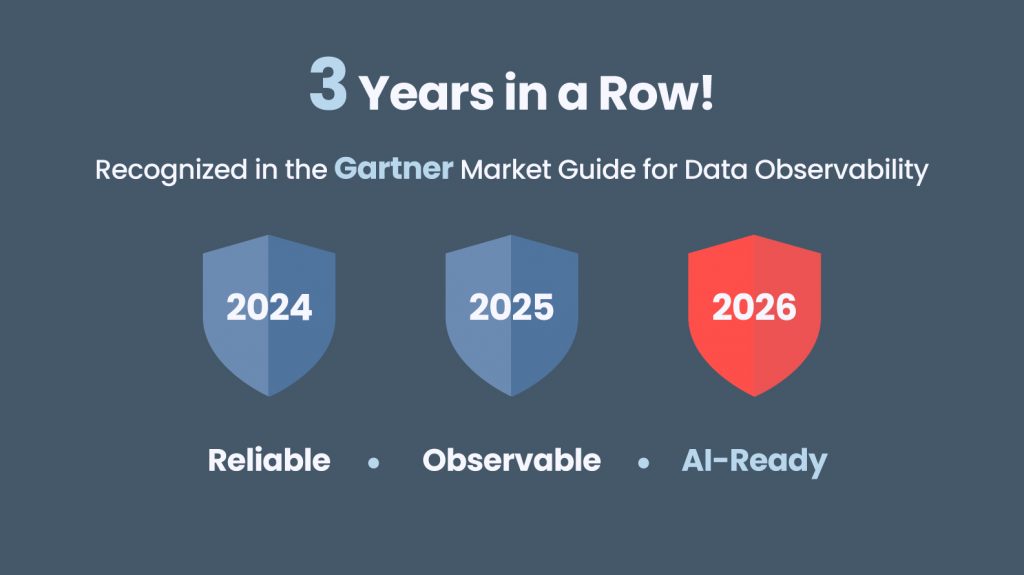
We’re proud to announce that Qualdo has been named a Representative Vendor in the Gartner® Market Guide for Data Observability Tools for the third consecutive year – recognized in the 2024, 2025, and 2026 editions.
In a category that has gone from emerging to mission-critical in under five years, this sustained recognition reflects not a milestone, but a momentum. It is building on continuous product evolution, deepening customer trust, and a bold thesis:
“In a world where AI depends on trustworthy data, enterprises need data that is Reliable, Observable, and AI-Ready.“
Why the Gartner Market Guide Matters Right Now
A Gartner Market Guide is not a ranking – it is a structured research publication that helps data and analytics (D&A) leaders understand market direction, mandatory capabilities, and representative vendors actively participating in a category.
CDOs, Heads of Data Platform, and AI leaders use it to benchmark their stack decisions against what Gartner’s analysts see across thousands of enterprise conversations. And right now, what those analysts are seeing is a market at a tipping point.
The numbers tell the story clearly:
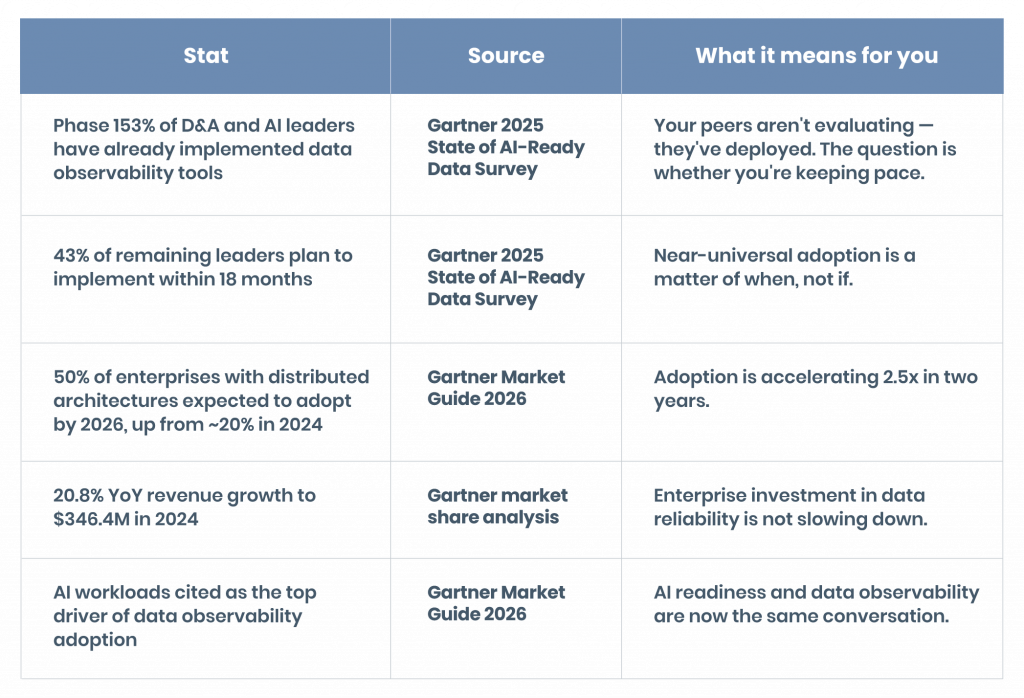
- According to Gartner’s 2025 State of AI-Ready Data Survey, 53% of D&A and AI leaders have already implemented data observability tools, with 31% planning to do so within 6–12 months and 12% within 12–18 months — meaning the vast majority of enterprises are moving on this now.
- 50% of enterprises implementing distributed data architectures are expected to have adopted data observability tools by 2026, up from approximately 20% in 2024, according to Gartner.
- The data observability market grew at 20.8% year-on-year in 2024, reaching $346.4 million in revenue, according to Gartner market share analysis.
What this means for you: Data observability is no longer a data engineering pet project. It is a foundational layer for trustworthy analytics and AI — and your peers are already investing in it.
The Shift Gartner Is Highlighting: From Data Quality to Data + AI Observability.
There’s a critical distinction that Gartner draws, and one that shapes how modern data teams should evaluate tools.
Traditional data quality tools focus on the data itself: static rules, test assertions, threshold checks. They’re good at catching what you already know to look for. Data observability, as defined by Gartner, goes further. In Gartner’s own words: “Data observability tools learn what to monitor and provide insights into unforeseen exceptions. They fill the gap for organizations that need better visibility of data health and data pipelines across distributed landscapes well beyond traditional network, infrastructure, and application monitoring.”
Gartner defines five areas that data observability solutions must monitor:
- Data content — quality and validity of the data itself
- Data flow and pipeline — interruptions and failures within data pipelines
- Infrastructure and compute — evolution of code and compute consumption
- User, usage, and utilization — how data is accessed and by whom
- Financial allocations — resource costs of data operations over time
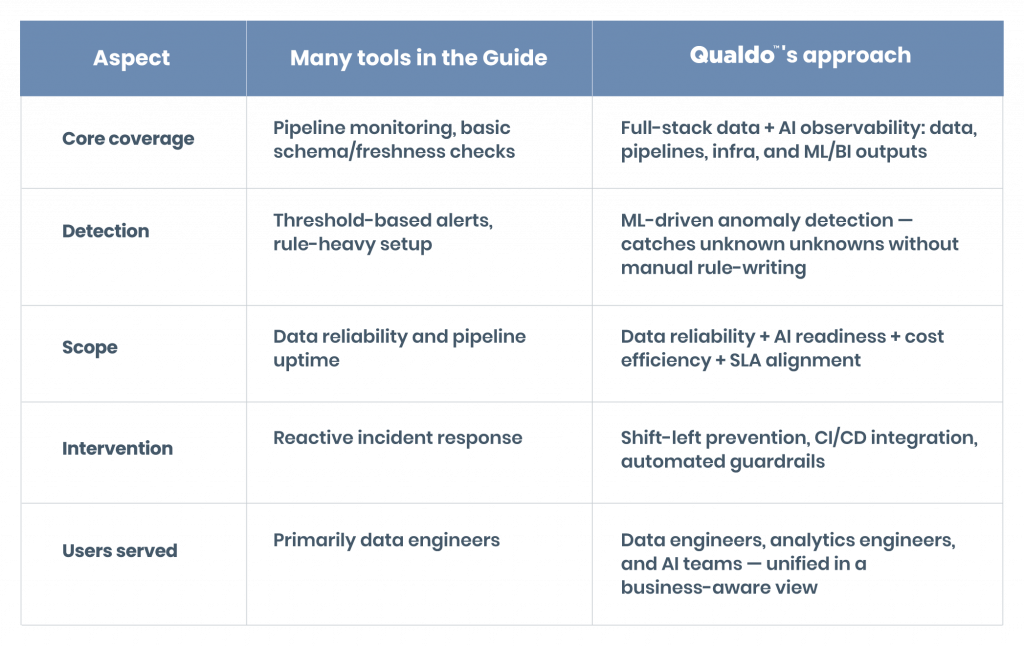
Qualdo is for this broader, AI-era definition of observability — not just table-level checks. The five pillars of freshness, volume, schema, distribution, and lineage are your baseline. The real differentiators are what sit on top: ML-driven learning, AI-ready pipeline coverage, and business-outcome alignment.
What the 2026 Guide Is Telling Data and AI Leaders
The 2026 Gartner Market Guide (Melody Chien, Michael Simone, 23 February 2026) surfaces four major themes that every CDO and Head of Data should act on:
1. AI workloads are now the #1 driver — and the #1 risk.
AI and machine learning initiatives have moved from experimentation into production at scale. The quality of the data those models depend on is now a business-critical concern. In agentic AI scenarios, bad data doesn’t just produce an incorrect report — it can also trigger an autonomous agent to take the wrong action entirely. Gartner flags semantic drift monitoring as critical: subtle shifts in data meaning must be detected before they compromise model reliability or introduce bias.
2. End-to-end visibility across distributed architectures is now table stakes.
No single warehouse, no single cloud, no single pipeline. Modern data estates span cloud warehouses, lakehouses, streaming platforms, BI layers, and ML outputs. Gartner expects observability coverage to match that complexity — not just monitor one layer.
3. Tools must shift from reactive to proactive.
The 2026 Guide strongly signals a shift from detecting failures after they occur to predictive and proactive remediation — forecasting data quality degradation, resource exhaustion, and cost anomalies before they cause downstream impact. Shift-left approaches, CI/CD integration, and automated guardrails are rapidly becoming standard expectations rather than advanced features.
4. Observability must tie to business outcomes.
SLA adherence, AI model reliability, cost savings from reduced failed jobs and re-runs, and executive trust — these are the outcomes data leaders are accountable for. Gartner’s guidance reinforces that observability tools must map technical signals to business value, not just emit alerts into a vacuum.
Three Years of Gartner Recognition: What It Reflects About Qualdo’s Journey
Being named a Representative Vendor once can reflect a promising product. Being named three consecutive years reflects sustained relevance, continuous product evolution, and compounding customer trust.
Here is how Qualdo’s three years of recognition map to our product journey:
2024 (First year): Establishing core data observability across pipelines and critical data products — proving that reliable, automated monitoring at scale was achievable without months of rule-writing.
2026 (Now): Doubling down on AI-powered anomaly detection, root-cause analysis, and AI-ready data reliability at scale — aligning with the market’s shift toward agentic AI and proactive observability.
Three Years of Gartner Recognition. One bold mission: to make enterprise data Reliable. Observable. AI-Ready.
How Qualdo Aligns With — and Extends — Gartner’s View
Qualdo delivers observability not just over data tables, but across the full system: data content, pipelines, infrastructure, code paths, and ML/BI outputs. This aligns directly with Gartner’s five monitoring categories and its view that observability must cover the environment that delivers data, not just the data itself. Qualdo supports cloud warehouses (Snowflake, BigQuery, Redshift, Databricks), lakehouses, streaming architectures, and BI/ML output layers — wherever your data lives and moves.
AI-Powered Detection of “Unknown Unknowns”
The fundamental limitation Gartner identifies in traditional monitoring is that it only catches what teams already know to look for. Qualdo’s ML-driven anomaly detection learns baseline patterns across freshness, volume, distribution, schema, and business KPIs — surfacing deviations that no human-written rule would have caught. When an anomaly is detected, Qualdo provides enriched context for root-cause diagnosis and automated impact analysis, so your team spends minutes resolving issues, not hours triaging them.
Shift-Left and Preventive Observability
Reactive observability is expensive — incidents discovered in production mean broken dashboards, failed reports, and eroded stakeholder trust. Qualdo enables upstream checks and CI/CD integration, so data quality issues are caught before they reach production. This shift-left approach embeds observability into development workflows, data contracts, and deployment pipelines — turning your data team from incident responders into reliability architects.
Business-Aligned Outcomes
Qualdo maps technical signals to business accountability: SLA adherence rates, hours of report downtime avoided, AI model reliability scores, and direct cost savings from reducing failed pipeline re-runs.
Illustrative example: A large financial services customer reduced mean time to incident detection by over 60% and eliminated recurring downstream report failures that had previously consumed 15+ engineering hours per week — translating directly to improved SLA performance and increased stakeholder trust in AI-driven decisioning outputs.
Key Gartner Stats Every CDO Should Save
Here is a concise reference set of verified, Gartner-attributed figures for your internal and external conversations. All figures below are from Gartner’s 2026 Market Guide and the 2025 State of AI-Ready Data Survey:
Where Qualdo Stands in the Landscape
Gartner sees a fast-growing, rapidly maturing category. Qualdo is purpose-built for the AI era of observability — where the stakes are not just broken dashboards but broken AI decisions.
Customer, Partner, and Community
Three years of Gartner recognition ultimately reflect what data teams experience every day with Qualdo. Here are three anonymized scenarios that represent the outcomes our customers are achieving:
- Global Financial Services firm: Reduced time to detect data incidents in critical reporting pipelines by over 60%, enabling the team to meet SLA commitments consistently for the first time after migrating to a multi-cloud architecture.
- Large-Scale E-commerce platform: Eliminated recurring ML feature store freshness failures that had been causing silent model degradation — improving AI recommendation reliability and directly contributing to revenue outcomes.
- Enterprise Healthcare data platform: Used Qualdo’s cost observability to identify and eliminate $2M+ in annualized cloud data warehouse waste from inefficient, unmonitored pipeline re-runs.
Three years of Gartner recognition. One bold mission. Now is the time to make your data AI-ready.
Whether you’re a CDO building the case for observability investment, a Head of Data Platform evaluating tools, or an AI engineering lead dealing with silent model failures — Qualdo-DRX is built to meet you where your data complexity lives.
→ Explore how Qualdo-DRX can plug into your existing stack at qualdo.ai