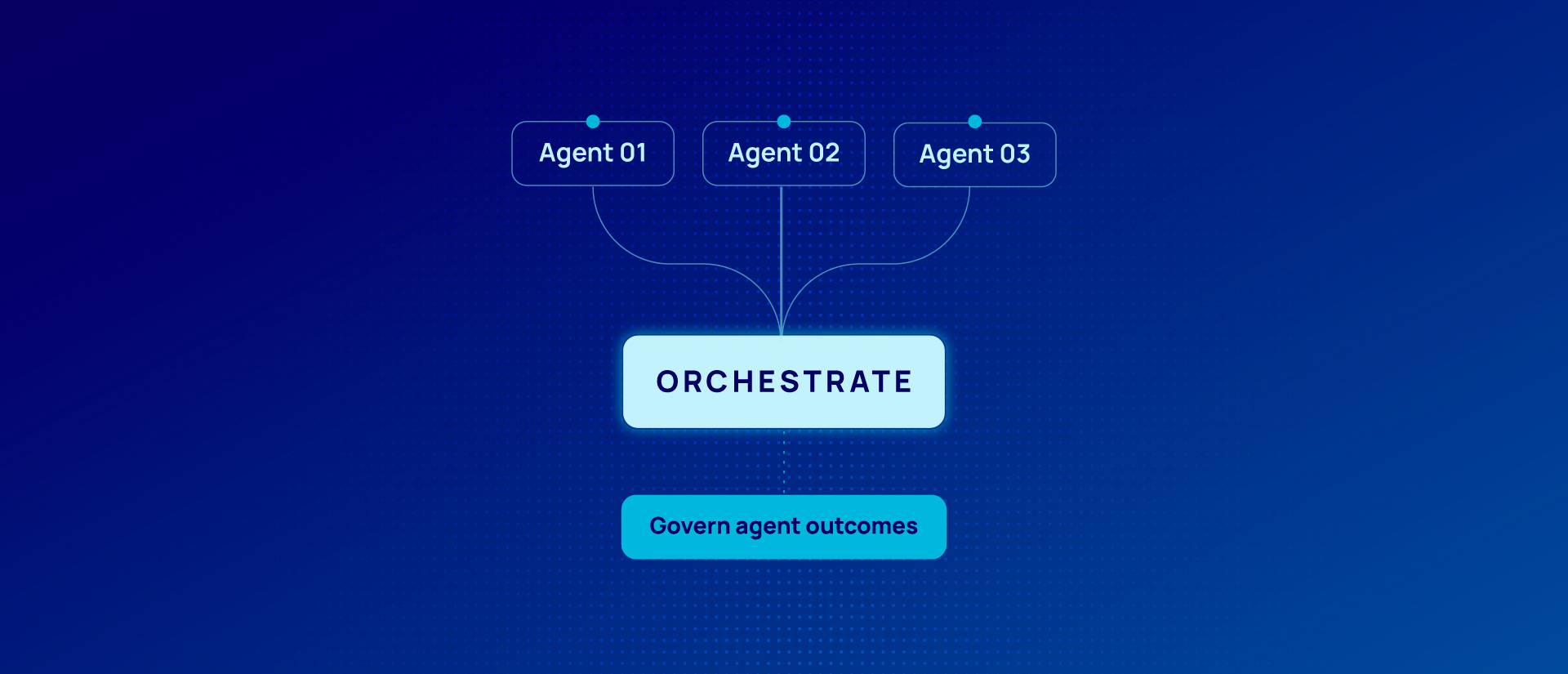
A source system adds a new inventory field overnight. Normally, that change would move through a familiar process. Someone raises a ticket. The schema change is reviewed. A transformation is updated. Downstream dependencies are checked. The release is scheduled.
But this time, an agent sees the new field and updates the transformation itself.
Another agent adjusts a downstream model so the pipeline keeps running. Nothing fails. No alert turns red. By morning, the architecture diagram still looks exactly the same. The system underneath it does not.
That is the uncomfortable change arriving for Data Architects. As agents become capable of generating transformations, schemas, integrations, and new technical paths, architecture can no longer assume that every meaningful change begins with a human design decision.
Data architect skills for AI agents are increasingly the skills that keep a data estate reliable while parts of it change dynamically: contracts, boundaries, access rules, lineage, and blast-radius judgment.
The future Data Architect is not going to design every path an agent takes. They are going to decide which paths are allowed.
How Will AI Agents Change the Data Architect Role?
Data Architects have always worked with change. New applications arrive, businesses reorganize, platforms migrate, schemas evolve, and new data sources enter the estate.
What changes with agents is the speed and the source of that change.
An AI agent can generate a transformation, choose an integration path, modify code, or introduce a dependency without every intermediate decision being designed manually. That does not mean the agent suddenly owns the architecture. It means the architect has to design an environment where those changes can happen without quietly weakening the system.
This shifts the role from designing relatively stable structures toward designing controlled change.
The architect still decides how domains interact, where data belongs, which interfaces should exist, and which systems can access what. But increasingly, those decisions have to be expressed as rules that both people and machines can follow.
From Designing Stable Structures to Designing Constraints Around Change
Traditional architecture diagrams describe the system as it is supposed to work. Agentic systems add another question:
What is allowed to change without redesigning the system first?
Some changes may be safe to automate. A transformation can adapt to a non-breaking source update. Documentation can be regenerated. A mapping can be suggested. Other changes should stop immediately.
An agent should not silently change the business meaning of a field used by multiple domains. It should not create a dependency across a restricted boundary because it discovered a faster route. It should not alter an interface that five downstream applications rely on simply because the new version works for its current task.
The Data Architect therefore starts spending more time defining limits around autonomy.
What can change automatically? What requires review? Which contracts are non-negotiable? And if a change goes wrong, how quickly can the system return to a known state?
The Future Data Architect Designs the Rules, Not Every Path
This is similar to designing a city. The architect cannot decide where every car will drive tomorrow. But they can decide where the roads are, which streets are one-way, where vehicles cannot enter, and what happens when a route is closed.
Agentic architecture works in much the same way.
You do not need to manually prescribe every route an agent might take. You do need enough structure that an agent cannot create a shortcut through something the enterprise intended to protect. That makes architecture principles more important, not less.
Why Architecture Can No Longer Assume Change Is Manual
Architecture processes were largely built around humans making changes.
A developer updates a model. An engineer creates an integration. A team proposes a new dependency. Someone reviews it before it reaches production. Agents compress that cycle.
McKinsey’s 2026 State of AI research found that 40% of respondents at large organizations said they were already scaling AI agents, up from 27% the year before. Agentic coding tools are also becoming one of the earlier areas of enterprise adoption.
As more of that work moves from assistance toward execution, the architecture review process cannot be the only control point. The rules need to exist inside the system itself.
That is why the next generation of architecture will depend more heavily on machine-readable policies, contracts, permission boundaries, lineage, and automated checks.
THE ARCHITECTURE DIAGRAM DIDN’T CHANGE.
THE SYSTEM UNDERNEATH IT DID.
The architect’s job is increasingly to make sure that invisible change is still governed change.
Why Are Data Contracts Important for AI Agents?
Go back to the inventory field. The agent updated the transformation correctly. The downstream model still runs. From a pipeline perspective, everything looks healthy.
But what did the field actually mean?
Was the old value physical stock on hand? Does the new value exclude reserved units? Is it now calculated after ecommerce allocation? Has freshness changed? Can downstream systems still interpret it the same way? Those questions belong in a data contract.
A useful contract does more than say that a column exists. It establishes what other systems are entitled to expect from that data: schema, business meaning, freshness, ownership, interfaces, compatibility, and other critical rules. That becomes particularly important when the consumer on the other side is also an agent.
Gartner’s 2026 guidance on agentic-AI-ready data products specifically points to machine-verifiable data contracts, active metadata, governance, and DataOps practices as foundations for reliable human and machine consumption.
In other words, the architecture cannot depend on someone remembering what a field was supposed to mean. The expectation needs to travel with the data.
Downstream Impact When an Upstream Agent Changes a Field
A local change rarely stays local.
That inventory field may feed an e-commerce site deciding whether an item is available. It may influence replenishment. A warehouse planning system may use it to prioritize movement. A demand model may consume it as a feature. An AI assistant may use the same value when answering a store manager’s question about stock.
The transformation can be technically correct and still produce a business problem several systems away. This is where the Data Architect’s responsibility becomes less about whether the change works and more about how far the change is allowed to travel.
How Should Data Architects Design Boundaries for Autonomous Agents?
An autonomous agent should not receive universal freedom simply because it can complete the task. The architect needs to classify the estate.
Some areas may allow autonomous change within defined limits. Others may allow an agent to recommend a change but require approval before execution. Sensitive domains may remain read-only. Certain interfaces may never be modified automatically because too many downstream systems depend on them.
The important part is making those distinctions explicit. For example, an agent could be allowed to generate a new transformation inside a sandboxed domain but prevented from publishing a breaking schema change to a shared interface. It may suggest a new cross-domain dependency, but creating that dependency could still require architectural approval.
Rollback needs the same attention.
If an automated change creates an unexpected consequence, the system should know which version was previously valid, which dependencies were affected, and how to restore the prior state without creating another incident. Autonomy without rollback is not flexibility. It is risk moving faster.
How Do AI Agents Affect Data Lineage and Dependencies?
Architecture diagrams capture intended relationships. Lineage shows what is actually happening.
That difference becomes more important when agents can generate new technical paths. An architecture diagram may say System A feeds System B, but an agent-generated workflow may introduce another transformation, API call, or dependency in between. If those relationships are invisible, the architect loses the ability to understand the blast radius of a change.
McKinsey’s 2026 work on agentic AI architecture makes a similar point: as agents coordinate multiple models and data sources, enterprises need stronger lineage, traceability, access controls, common definitions, and governed interfaces.
For Data Architects, lineage therefore becomes more than troubleshooting information. It becomes part of design.
Practical Example: A Retail Inventory Field Change
In retail, an inventory change does not live neatly inside an inventory table.
Availability may be connected to ecommerce allocation, store stock, promotions, replenishment, warehouse planning, pricing decisions, and supply-chain activity. Qualdo’s vertical observability approach reflects this by looking at business-specific signals such as inventory, pricing, promotions, ecommerce, and supply chain together rather than treating them only as isolated technical metrics.
For an architect, that is the useful lesson. When the upstream field changes, the question is not simply whether the pipeline completed successfully.
IWhich business systems now behave differently because of that change?
That is why dependency visibility and observability begin to sit much closer to architecture. If change can happen faster, its consequences need to become visible faster too.
Semantic Architecture Matters Too
The previous part of this series looked at how the Analytics Engineer increasingly owns shared metric definitions and the semantic layer. The Data Architect has a related problem at a wider level.
A business definition is useful only if its meaning survives as data moves across systems, domains, applications, and AI interfaces. Consider revenue.
An Analytics Engineer may help define exactly what “recognized revenue” means. But if one application receives the definition, another consumes only a raw field, and a third agent infers its own meaning from metadata, the enterprise still has a consistency problem.
The Data Architect therefore has to think about semantic architecture alongside physical architecture.
Which business entities are shared? Where do authoritative definitions live? How are those definitions exposed to agents? What happens when two domains legitimately use different meanings for the same term?
The Analytics Engineer helps define the metric. The Data Architect helps ensure the definition survives the journey.
What Data Architecture Skills Will Matter in 2027?
The Data Architect is not moving away from technical architecture.
But some of the work around first-pass schemas, integration code, dependency mapping, and documentation will increasingly be assisted or generated by agents.
That raises the value of the decisions that cannot safely be delegated.
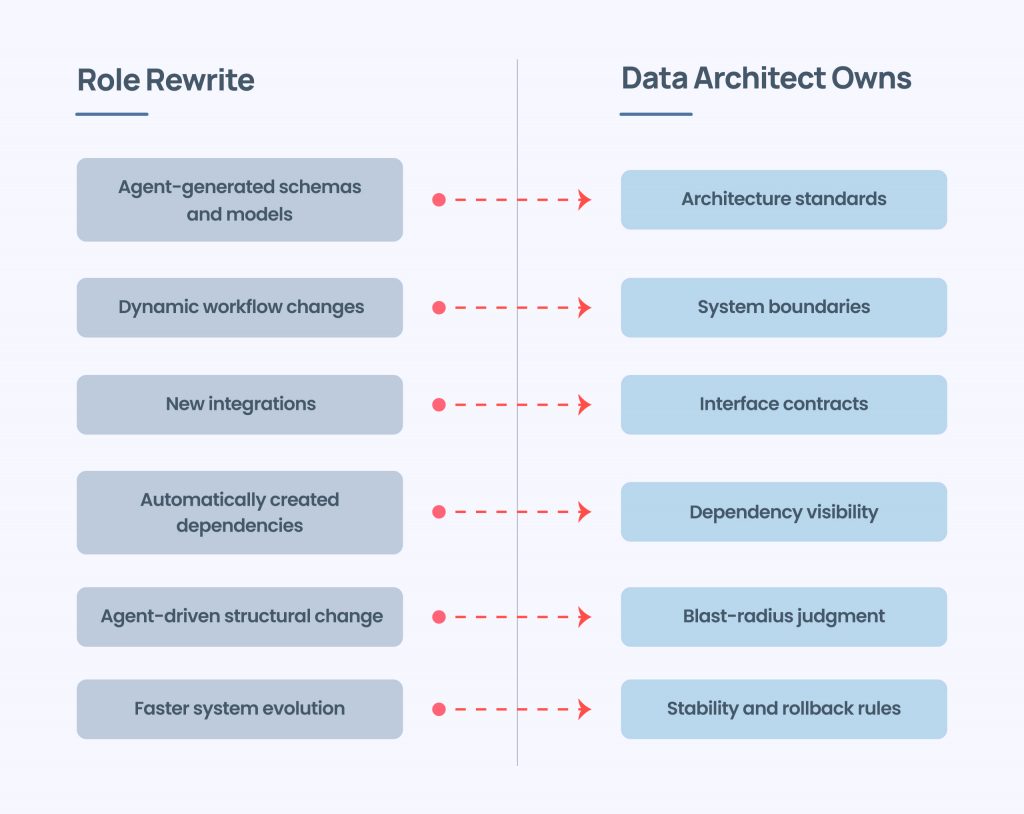
Data contracts become more important because systems need explicit promises. Lineage becomes more important because dependencies can appear faster. Permission boundaries become more important because agents can act, not just recommend. Semantic architecture becomes more important because agents need business meaning alongside technical access.
The architect’s value moves toward the rules that let everything else move quickly without losing control.
What the Data Architect Role Looks Like in 2027
The Data Architect will still design systems, domains, interfaces, and standards.
The difference is that the final architecture may no longer be something a human team designs once and then changes deliberately over time. Parts of it will evolve continuously.
The strongest architects will therefore design for that reality from the beginning. They will create systems where agents have enough freedom to solve problems without enough freedom to quietly redefine the estate.
They will know which changes can happen automatically, which ones need approval, how dependencies are discovered, how meaning remains consistent, and how to contain the blast radius when something goes wrong.
The old architecture question was:
What should the system look like?
The new one is:
How do we let the system change without losing control of what it becomes?
That may be the defining Data Architect skill of the agentic era.
FAQs
How will AI agents change the Data Architect role?
AI agents can generate queries, transformations, schemas, and new dependencies without every step being manually designed. The Data Architect therefore shifts from specifying every technical path toward establishing contracts, boundaries, permissions, and rollback rules that keep agent-driven change controlled.
Will AI replace Data Architects?
Agents can assist with schemas, integrations, dependency mapping, and documentation, but they do not own architectural trade-offs. Decisions about domain boundaries, business meaning, blast radius, permissions, and what must never change automatically remain architecture responsibilities.
What data architecture skills will matter in 2027?
Data contracts, dependency and lineage visibility, domain boundaries, permission design, semantic architecture, rollback, and blast-radius judgment become increasingly important. Architects will need to design systems that can evolve quickly while preserving stable interfaces and business meaning.
Why are data contracts important for AI agents?
Data contracts define what downstream systems can rely on, including schema, meaning, freshness, ownership, and compatibility. When agents can change upstream logic quickly, those explicit expectations help prevent a local change from silently breaking other systems.
How should Data Architects design for autonomous agents?
Start by defining what agents can modify automatically, what requires approval, which domains are read-only, and how rollback works. Those rules should be enforceable at system and interface boundaries rather than depending on manual review of every agent action.
What is AI-ready data architecture?
AI-ready data architecture gives agents reliable access to data along with the context and controls needed to use it safely. That includes business meaning, metadata, lineage, permissions, stable interfaces, and governance that can continue working as systems change dynamically.
How do AI agents affect data lineage and dependencies?
Agents can create new dependencies more quickly than static architecture documentation can reflect them. Lineage therefore becomes essential for showing where data moved, what depends on it, and how far an automated change travelled across the estate.
Key Takeaway
AI agents make it easier to create new technical paths through an enterprise data estate.
That does not make architecture less important. It changes what architecture is for.
The Data Architect of 2027 will spend less time trying to design every possible path and more time making sure that whatever path gets created still respects the contracts, boundaries, meaning, and controls the business depends on.
The architecture does not have to stay still. The rules around it do.
Coming next in The Data Role Rewrite
The Career Starter, whose first tasks are already being done by AI, now has to prove what they can do beyond them.