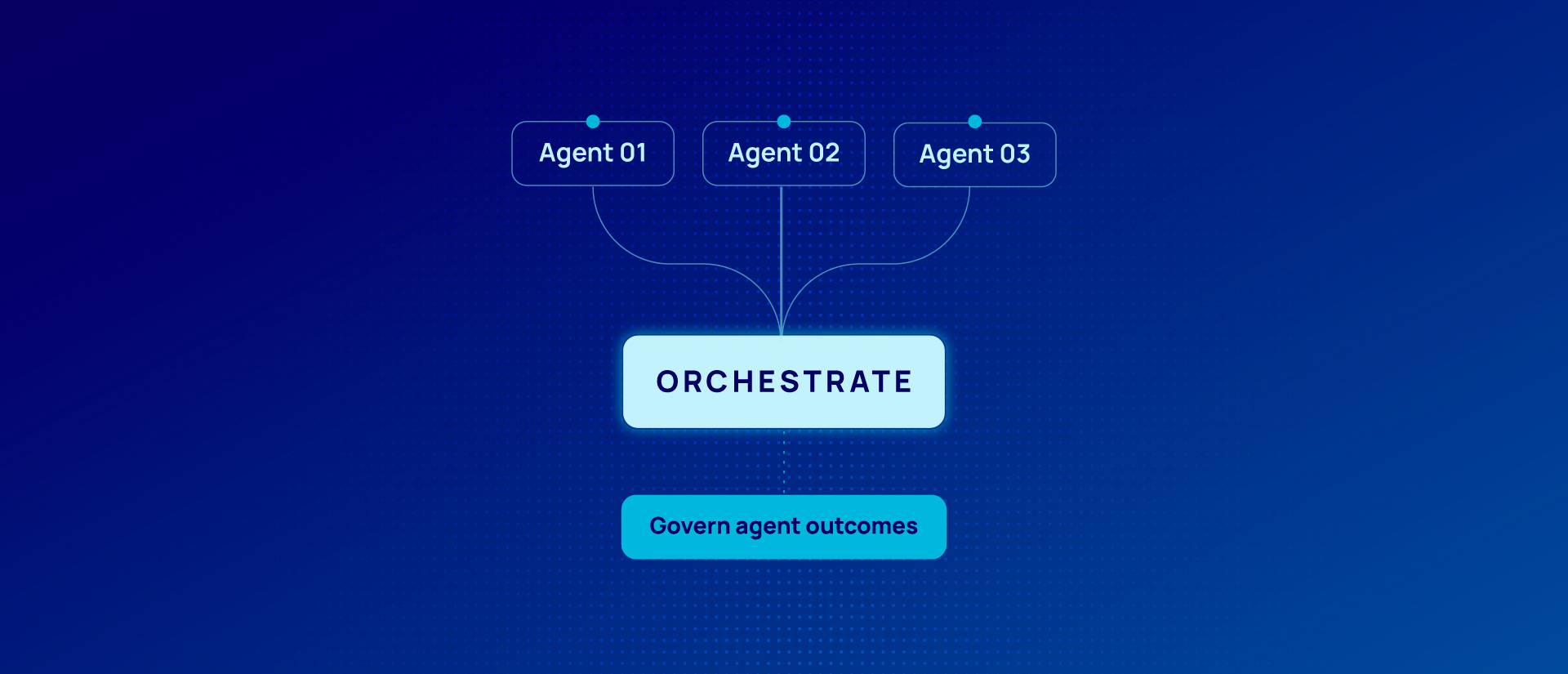
An ML Engineer deploys a new agent into production.
It has a clear task, access to three tools, a system prompt that worked well in testing, and a fallback model ready if the first one fails.
By the end of the week, the agent has made hundreds of decisions. Some are straightforward. Some involve another agent. Some trigger tool calls. A few take longer than expected. One reaches the right answer through a path nobody designed.
The model itself is only one part of the problem now.
This is where ML engineer skills for agent orchestration start to look different. The work is moving beyond training and serving individual models toward deciding how agents are instructed, connected, evaluated, monitored, constrained, and stopped.
For the ML Engineer, production increasingly looks less like managing one model and more like managing a team that happens not to be human.
How the ML Engineer Role Is Changing
The traditional ML lifecycle had a familiar rhythm: train the model, validate it, deploy it, monitor performance, retrain when necessary.
That rhythm does not disappear. But agentic systems add another layer.
That shift is already showing up in production. Anthropic’s 2026 State of AI Agents Report found that 57% of businesses are using AI agents for multi-step workflows.
An agent can choose tools, make intermediate decisions, hand off work to another agent, retry a failed step, or follow a path that was never explicitly coded.
Suppose an enterprise uses agents to investigate a pricing anomaly.
One agent retrieves transaction data. Another compares store-level pricing. A third checks recent promotions. A fourth decides whether to escalate the issue.
Each agent may work correctly on its own, and the overall workflow can still fail.
The wrong agent may receive the task. One may call a tool it should not have access to. Two agents may repeat the same work. A retry may create a loop. Or the final agent may act on an earlier answer that was plausible but wrong.
The ML Engineer is no longer asking only, “Is the model performing?”
The question becomes, “Is the system behaving the way we intended?”
That is why orchestration and evaluation move closer to the center of the role. The engineer needs to know which agent owns each decision, what evidence it should use, where a handoff is allowed, what counts as success, and what should happen when confidence drops.
The model still matters.
But the behavior around the model starts carrying just as much operational risk.
The Agent Lifecycle Starts to Look Like Management
The management comparison works because an agent needs many of the same things a new team member needs before you trust them with important work.
- Hire – choose the right model or agent for the task.
- Onboard – provide instructions, tools, permissions, context, and boundaries.
- Brief – define the task, expected output, success criteria, and what the agent should never do.
- Coordinate – decide how agents divide work and hand tasks to one another.
- Review – evaluate task completion, tool use, consistency, and failure behavior.
- Budget – manage model calls, tokens, latency, retries, and infrastructure cost.
- Intervene – define fallbacks, human escalation, and recovery when something goes wrong.
- Fire – deprecate, replace, or roll back an agent that no longer performs reliably.
The metaphor has limits, of course. Agents are software systems.
But the engineering responsibility is starting to resemble management in one important way: giving something autonomy does not remove your responsibility for what it does.
The First Production Job Is Agent Onboarding
A working demo proves that an agent can complete a task.
It does not prove the agent can be trusted to do that task repeatedly in production.
System prompts are only the beginning.
A production-ready agent also needs a clear set of tools, restricted permissions, the right context, and an explicit understanding of where its authority ends.
An inventory agent, for example, may need permission to read stock levels but not change replenishment quantities without approval. A support agent may retrieve account information but need human confirmation before issuing a refund.
Those boundaries are architecture decisions, not prompt-writing details.
Context and memory need the same level of attention.
More context is not automatically better. An agent needs enough information to complete the task without being buried in irrelevant history or carrying stale assumptions from an earlier interaction.
Memory creates the same trade-off. Remembering useful state can improve continuity, but outdated state can quietly influence a later decision.
The ML Engineer must decide what the agent should remember, for how long, and when to ignore or refresh that memory.
A demo usually shows the happy path. Production introduces incomplete inputs, unavailable tools, conflicting instructions, retries, unusual user behavior, model updates, and decisions that have consequences outside the chat window.
A simple production-readiness check should ask
- Does the agent know when to stop?
- Are its tool permissions limited to what the task requires?
- Can a failed tool call recover safely?
- Is there a measurable definition of success?
The harder part begins after the first successful run.
ML Engineer Skills for Agent Orchestration
Agent orchestration is designing how multiple AI agents are assigned tasks, routed, coordinated, and stopped within a production workflow.
That sounds straightforward until several agents begin making decisions at the same time.
Good orchestration starts with responsibility.
If one agent retrieves customer information and another recommends an action, the boundary between those jobs needs to be clear. Otherwise, the workflow ends up with overlapping logic, duplicated calls, and agents assuming work another agent has already done.
The ML Engineer must decide when specialization helps and when another agent just adds complexity.
Handoffs need the same discipline.
The receiving agent should get the relevant context, the task state, what has already been checked, and what remains unresolved.
Poor handoffs create the machine equivalent of a meeting where nobody knows what happened before they joined.
Multi-agent orchestration therefore becomes as much about state and ownership as routing. The gap between experimenting with agents and orchestrating them at scale is still significant. Deloitte’s 2026 research found that only 15% of organizations have scaled orchestrated, cross-functional multi-agent adoption
And the workflow also needs to know when to stop.
Without a clear stopping condition, an agent may retry, ask another agent, call another tool, and continue spending time and compute without materially improving the result.
Some workflows should stop when confidence drops. Others should escalate when a specific business rule triggers.
Human-in-the-loop is not a failure of orchestration. Sometimes it is the correct final step.
AI Agent Evaluation and Monitoring: Evals Are the New Unit Tests
A traditional unit test can check whether a known input produces an expected output.
Agents are harder to test because several valid paths can lead to the same result.
That means AI agent evaluation and monitoring need to look at both the outcome and the journey.
The first question is whether the agent completed the task.
The next questions are more revealing: Did it select the right tool? Did it use the tool correctly? Did it respect its permissions? Did it take unnecessary steps? Does it behave consistently when the same scenario appears again?
An eval suite starts becoming the equivalent of regression testing for agent behavior.
After deployment, the picture gets wider.
A model can drift. Feature distributions can change. Response quality can decay. Latency can increase. A downstream data change can alter an otherwise unchanged workflow.
This is where model monitoring still matters inside an agentic system.
What “good” looks like also changes by industry. In retail, an agent workflow may need to be evaluated against inventory availability, promotions, replenishment, and pricing signals. In manufacturing, the same orchestration logic may depend on production quality, downtime, or material availability.
The engineering pattern may be similar, but the business signals that determine whether the agent is behaving correctly are not.
That is where Qualdo’s vertical observability approach matters: connecting data and AI behavior to the KPIs and operational signals that matter in each line of business, instead of treating every workflow as if the same checks apply everywhere.
Managing Cost and Latency in Agent Workflows
One agent call is easy to budget.
An agent that calls another model, queries two tools, retries one failure, asks another agent to validate the answer, and then generates the final response is a different system entirely.
Each step adds cost and latency.
The ML Engineer therefore needs to ask practical questions.
Does every step need the most capable model? Can two independent tool calls run in parallel? Is an extra validation agent worth the latency? Should the workflow retry automatically or escalate after the first failure?
A workflow that is technically impressive but too slow or expensive to use is not production-ready.
Failure Containment: Retries, Fallbacks, Rollback and Deprecation
Agents will fail.
The useful engineering question is not how to guarantee that they never do. It is how far a failure is allowed to travel.
A failed retrieval can trigger a retry. A model failure can move to a fallback. A risky action can require human approval. A degraded version can be rolled back.
What should not happen is one wrong decision quietly becoming a wider business incident.
That makes permission boundaries, checkpoints, tracing, rollback, and root-cause investigation part of the architecture.
The strongest agent system is not the one that never makes a mistake.
It is the one where mistakes are visible, contained, explainable, and recoverable.
What the ML Engineer Role Looks Like in 2027
The role is not moving away from engineering.
It is moving toward a wider definition of what needs to be engineered.
| Agent System Needs | ML Engineer Owns |
| Instructions | System design |
| Tasks | Orchestration |
| Resources | Cost and latency |
| Boundaries | Failure containment |
| Intervention | Human escalation |
| Replacement | Rollback and deprecation |
Training and serving models still matter.
What changes is where the responsibility ends.
The ML Engineer increasingly owns the behavior of a system made up of models, agents, tools, context, permissions, and handoffs. That requires model knowledge, systems thinking, evaluation design, and operational judgment.
The engineer who can make an agent work is useful.
The engineer who can tell when it should work, what it can do, how well it is performing, and when to take it out of service becomes much harder to replace.
FAQs
What skills do ML Engineers need for agent orchestration?
ML Engineers need systems design, model understanding, tool and permission design, evaluation, monitoring, cost management, and failure handling. They also need to understand how agents pass state and responsibility between one another. The role increasingly combines traditional ML engineering with distributed-system thinking and operational judgment.
How do you know an AI agent is ready for production?
A production-ready agent should have defined success criteria, restricted tool access, repeatable eval results, safe failure behavior, monitoring, and a clear escalation path. A successful demo is not enough. The agent should also be tested against incomplete inputs, tool failures, edge cases, and scenarios where it should refuse or stop.
How should multiple AI agents hand off work to one another?
A handoff should include the task state, relevant context, completed steps, unresolved questions, and the receiving agent’s responsibility. Clear ownership helps prevent duplicated work, loops, and conflicting decisions.
When should an AI agent escalate to a human?
Escalation makes sense when confidence is low, the requested action has significant business impact, required information is missing, policies conflict, or the agent reaches a decision boundary outside its authority.
When should an AI agent be deprecated or replaced?
Reconsider an agent when it repeatedly misses quality thresholds, creates high cost or latency, depends on obsolete tools, fails after model or data changes, or a simpler, more reliable workflow replaces it.
Is the ML Engineer role being replaced by AI agents?
Agents can take on more model development and operational tasks, but they also create new engineering responsibilities around orchestration, evaluation, monitoring, permissions, cost, and failure containment. The role is shifting from managing individual models toward managing larger agent systems in production.
Key Takeaway
The old ML Engineering question was often:
Can we get this model into production?
The next question is harder:
Can we trust a system of agents to keep doing the right work once it gets there?
By 2027, the ML Engineer may spend less time personally training every model and more time deciding which agents get the job, what they can do, how their performance is reviewed, and when to take one out of service.
That sounds a little like management.
Because increasingly, it is.
Coming next in The Data Role Rewrite
The Data Analyst – who stopped pulling numbers and started interrogating the ones that appeared on their own.