
For years, data science teams complained that too much of the job happened before the interesting work began. Before a model could be useful, the data had to do more than be clean. It had to be aligned with the business KPIs, operating context, and priorities of the specific line of business the model was meant to support.
Agents are starting to reduce that preparation tax. They can profile datasets, draft cleaning logic, generate exploratory analysis, suggest features, and produce baseline models with much less manual effort.
Some of that work will not evolve into a more strategic responsibility. It will simply require fewer hours and, in some cases, fewer people. That is the uncomfortable part of how data scientist roles change with AI agents.
The role is moving away from executing every step of model development. More value will sit in defining the problem, designing the experiment, checking the agent’s choices, and deciding whether machine learning belongs in the solution at all.
In Part 1: The Data Engineer, the role shifted towards reviewing agent-written pipelines. Part 2: The Data Analyst explored what happens when first-pass answers become easier. For the data scientist, the next question is what happens when producing the first model becomes easier too.
How Data Scientist Roles Change with AI Agents
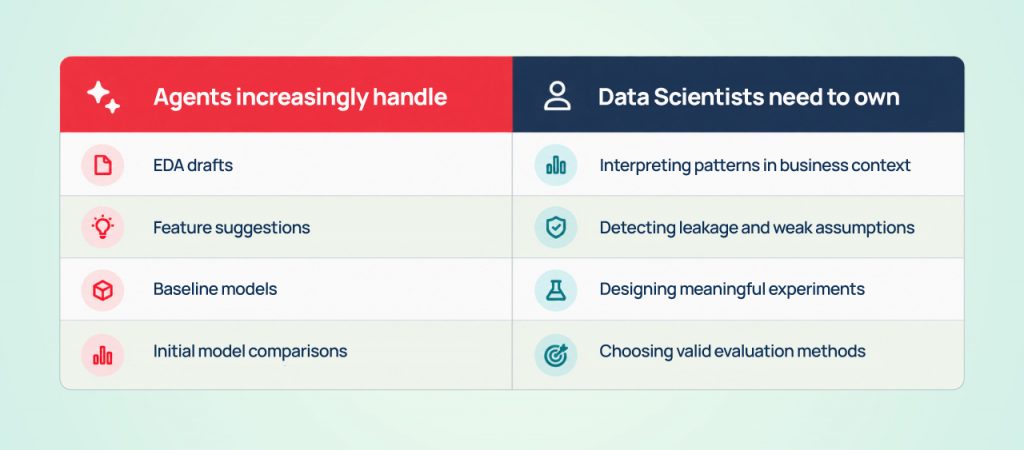
AI agents can take on more data preparation, exploratory analysis, feature generation, and baseline modeling. Data Scientists still need to decide whether the data represents the problem correctly, whether the experiment can support the conclusion, and whether the resulting model is useful outside the development environment.
The 80% Problem in the Data Scientist Role
The claim that data scientists spend 80% of their time preparing data has been repeated so often that it is sometimes treated as a fixed rule.
It is better understood as shorthand for a long-standing frustration. Different surveys have produced different estimates, depending on who was surveyed and which tasks were included.
Anaconda State of Data Science, based on 3,493 respondents across 133 countries and regions, found that data professionals spent approximately 37.75% of their time on data preparation and cleansing. That is well below 80%, but still a substantial part of the working week.
Now, AI agents for data cleaning can inspect columns, flag missing values, draft transformations, and create the first version of an exploratory analysis. The data scientist still needs to review those choices, but the work no longer has to begin from a blank notebook.
The new challenge is not simply getting the data ready. It is knowing whether the automated preparation kept the information that matters.
How AI Agents Are Changing Data Scientist Model Development
Consider a retailer trying to understand why certain products repeatedly run out of stock.
An agent can join sales and inventory records, identify missing values, chart seasonal patterns, suggest demand-related features, and produce an initial forecasting model. This is the appeal of agentic AI model development: several connected tasks can be completed within one directed workflow.
But a faster workflow can still produce the wrong interpretation.
Suppose the agent sees falling sales for one product and labels the pattern as declining demand. A Data Scientist familiar with the business may notice that the product was unavailable in several stores during the same period. Sales fell because customers could not buy it, not because they had stopped wanting it.
The numbers may be correct while the story behind them is wrong.
The 2026 AgentDS benchmark found that current agents still struggle with domain-specific reasoning. AI-only baselines performed below the strongest competition participants, while the best results came from human–AI collaboration.
That finding captures the role shift well. Agents can perform more of the workflow. Data Scientists remain responsible for recognizing when the workflow is built on a weak assumption.
What Data Scientists Still Need to Own
Once an agent can prepare the data and produce a workable model, three questions become more important:
- What are we actually trying to learn?
- Does the evaluation prove what we think it proves?
- Is machine learning the right response to the problem?
Why experiment design and causal reasoning matter more
Return to the retailer’s stockout problem.
A model may find that stores running more promotions also experience more stockouts. That does not prove promotions caused the shortages. Those stores may already have higher demand, slower inventory updates, or larger product ranges.
Prediction and explanation are not the same thing.
The Data Scientist has to decide what evidence would separate those possibilities. That may require a better comparison group, a controlled test, or a closer look at what changed before and after the promotion.
An agent can generate candidate models quickly. Experiment design determines whether any of them answers the business question.
Evaluating agent and model behavior
A model can also appear strong for the wrong reasons.
An agent might split forecasting data randomly rather than by time. It may include a feature that becomes available only after the outcome occurs. Or it may optimize for a metric that looks impressive but says little about the decision the business needs to make.
None of those problems has to break the code.
A meaningful review asks whether the model was tested under realistic conditions, whether its features would exist at prediction time, and whether that performance will hold once it moves into production ML pipelines.
As more of the workflow becomes automated, evaluation design matters more than simply reading the final score.
When machine learning is the wrong answer
Further investigation may show that the retailer’s real problem is not forecasting. Inventory updates may be arriving several hours late, leaving the replenishment system with an outdated view of stock.
Another model will not fix that.
The better response might be a more reliable inventory feed, a reconciliation rule, or a process change. Google’s ML problem-framing guidance recommends defining the goal first, comparing ML with simpler approaches, and checking whether the business can take useful action from the prediction.
Knowing when not to build a model is not a failure of data science. It shows that the problem was understood before time and money were spent solving the wrong thing.
Data Scientist vs AI Engineer in 2026–2027
The two roles increasingly overlap because both may work with models, agents, evaluation tools, and automated workflows. Their central responsibilities, however, are different.
A Data Scientist stays closer to the question, experiment, and evidence. They assess whether the model is appropriate, whether the evaluation is valid, and whether the result supports a useful conclusion.
An AI engineer stays closer to the system. Their work usually centers on integrating models, building agent workflows, deploying AI applications, and keeping them reliable in production.
In smaller teams, one person may do both. A useful distinction is this: the Data Scientist asks whether the model deserves to be used; the AI engineer makes sure the system can use it reliably.
What the Data Scientist Role Looks Like in 2027
Automation does not automatically mean the occupation disappears. The U.S. Bureau of Labor Statistics projects 35% employment growth for Data Scientists between 2025 and 2035, with an average of about 24,800 openings each year. These are U.S. projections, not a guarantee for every market, but they show that task automation and continued occupational demand can happen together.
What changes is the basis on which Data Scientists create value.
Python, SQL, statistics, and machine learning fundamentals still matter. So does understanding whether data reliability is strong enough for the model to support a useful conclusion.
What loses some advantage is routine execution by itself. Standard cleaning scripts, familiar EDA templates, and basic model-building workflows are becoming easier to generate.
What gains value is experiment design, causal reasoning, evaluation discipline, and domain depth.
In retail, for example, a good model still needs the right business context around inventory, pricing, promotions, replenishment, and store availability. That is why domain-specific reliability matters: the model has to reflect what is actually happening in the business, not just what the dataset appears to show.
At Qualdo, this is the same principle behind retail observability—connecting data reliability to the business signals and KPIs that matter in the line of business.
What Data Scientists Should Do Now
The practical response is not to collect every new agent framework. It is to become better at judging what those tools produce.
Start with familiar work. Let an agent draft an EDA or baseline model for a problem you already understand. Review the transformations, assumptions, features, and evaluation method rather than accepting the finished output.
Frame the problem before modeling. Define the business outcome, the action that could follow, and what a simple baseline might achieve.
Strengthen experiment and evaluation design. Learn to recognize leakage, weak comparison groups, unsuitable metrics, and results unlikely to hold outside the development dataset.
Go deeper into the domain. Understanding how the business operates will help you catch problems that are invisible in the code and difficult to infer from the dataset alone.
Tool breadth may help you move faster. Domain depth helps you know whether you are moving in the right direction.
Frequently Asked Questions
Will AI agents replace Data Scientists?
Agents will automate more data preparation, exploratory analysis, and baseline modeling. Some narrowly defined responsibilities may shrink. Data Scientists will still be needed to frame problems, design experiments, evaluate results, and connect models to meaningful outcomes.
What do Data Scientists do if AI handles data cleaning?
They review whether automated preparation is appropriate, preserves important patterns, and avoids bias or leakage. They can also spend more time on problem definition, experiment design, model evaluation, and interpretation.
What is the difference between a Data Scientist and an AI Engineer?
A Data Scientist focuses on whether data, experiments, and models support a valid conclusion. An AI Engineer generally focuses on building, integrating, deploying, and operating the systems that deliver AI functionality.
What skills should Data Scientists learn for 2027?
Core technical skills remain important. Data Scientists should also strengthen causal reasoning, experiment design, agent and model evaluation, problem framing, and industry-specific knowledge.
The Model Is No Longer the Whole Job
For years, much of data science revolved around the work needed to turn raw data into a functioning model. Agents are reducing that effort, and some familiar responsibilities will shrink.
But easier model development does not make every model useful.
By 2027, the Data Scientist who stands out may not be the person who produces the most models. It may be the person who knows which problem deserves a model, which evidence deserves to be trusted, and when the business needs something simpler instead.
Coming Next in The Data Role Rewrite
The Machine Learning Engineer – when agents can build and deploy models, who owns what happens in production?