
For years, one of the clearest signs of a useful analyst was how quickly they could turn a business question into something people could use. A request came in, the analyst pulled the data, wrote the query, checked the numbers, and built the report or dashboard.
That workflow is starting to change.
Self-service agents can already handle more of the first pass. They can answer straightforward “what happened?” questions, compare periods, generate charts, summarize trends, and suggest possible explanations. Work that once waited in an analyst’s request queue can increasingly be answered before the analyst becomes involved.
That does not make the analyst less important. It changes where the value sits.
The data analyst career path with AI agents is moving away from being defined by output alone. The analyst who stands out will increasingly be the one who understands what the business is really asking, knows when an answer needs another look, adds context the system does not have, and explains what the result means before somebody acts on it.
The role is becoming less about simply producing an answer and more about knowing whether the answer is worth using.
When the first answer becomes easier to get
The Microsoft Work Trend Index found that 81% of leaders expect agents to be moderately or extensively integrated into their AI strategy within 12–18 months.
For analysts, this means more ad hoc queries, simple comparisons, first-pass charts, and routine summaries may be completed before they become involved.
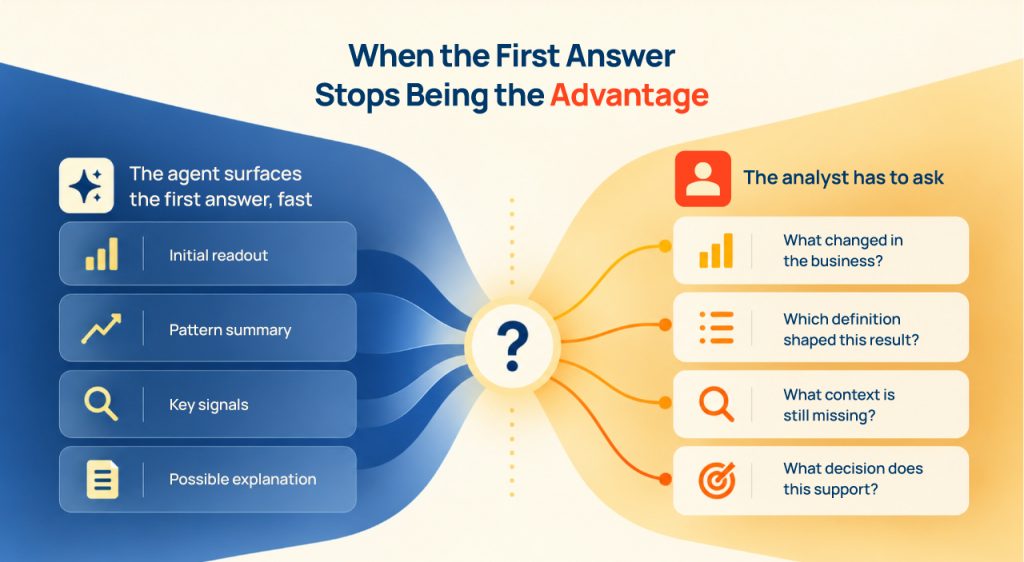
But getting a number quickly is not the same as understanding what the business needs to know. Consider the request, “Show me our best-performing customers.” Best-performing could mean highest revenue, strongest margin, frequent purchases, low return rates, or future value.
An agent can run each of those queries, but it cannot safely assume which definition fits the decision being made. That still requires business context and an understanding of what the stakeholder is actually trying to solve.
This is why question design becomes more valuable. As routine requests become self-service, the analyst moves beyond producing charts and starts shaping the question, checking the metric, and translating the result into something the business can use. The role shifts from report maker to decision translator.
The harder problem is an answer that looks right
Obvious errors are usually easy to catch. A broken chart, missing field, or impossible number tends to make someone stop and investigate. The harder problem is an answer that looks reasonable enough to accept.
An agent might report that conversion fell after a campaign. The calculation may be correct and the explanation may sound plausible. But perhaps the promotion ended during the same period, a popular product was unavailable, or one channel changed its pricing. Those details may not make the chart look wrong, but they can completely change what it means.
Changing business definitions creates a data contract problem too. Finance and sales may define an active customer differently, while marketing may use another time window for returning customers. The answer can be technically accurate and still fail to match the decision someone is trying to make.
The World Economic Forum’s Future of Jobs Report 2025 found that 69% of employers consider analytical thinking a core skill, making it the highest-ranked core skill in the report. That increasingly means testing whether a convincing conclusion still holds when the comparison period, customer segment, definition, or business context changes.
This is the stress-testing part of the role. Analysts do not need to distrust every agent-generated answer, but they do need to recognize which assumptions could change the conclusion. That skepticism matters because automated analysis can look finished before the thinking is finished.
Business context becomes part of the skill set
This is also where context engineering becomes relevant to data analysts.
In this case, context engineering is not about becoming better at writing elaborate prompts. It is about knowing what information an agent needs before its answer can be trusted.
An agent may see declining sales. The analyst may know that prices increased two weeks earlier. The agent may identify lower demand for a product. The analyst may know the product was unavailable across several stores. The agent may compare customer retention across periods, while the analyst knows the business changed how an active customer is defined.
Those facts can completely change the interpretation without changing the underlying calculation.
This is why business knowledge becomes more valuable as the mechanics of analysis get easier. SQL, visualization, and dashboards still matter, but they increasingly sit inside a bigger responsibility: understanding what is happening around the data.
For analysts thinking about where the role is headed in 2027, this is an important distinction. AI is not only changing how quickly analysis can be produced; it is changing which parts of the work still need an analyst’s judgment.
The data analyst who knows how the business operates has something the first-pass answer often does not: context.
The job gets closer to the people using the answer
The shift becomes even clearer when analysis reaches leadership. Executives rarely need a chart simply because a chart can be produced. They need to understand what changed, what might explain it, how confident the team is in the conclusion, and whether there is enough evidence to do something about it.
Gartner research on redesigning the data analyst role in the age of AI points in the same direction: as analytics becomes more automated, the analyst’s value moves toward combining data, technology, and business understanding to produce useful insight.
That means analysts increasingly need to own the narrative around their work.
Suppose an agent reports that customer retention has fallen by 6%. Passing that number to leadership is the easy part. The analyst still needs to understand whether the decline is concentrated in one customer segment, whether the retention definition changed, whether pricing or service issues affected the period, and whether the pattern is strong enough to justify action.
Sometimes the analyst will confirm exactly what the agent found. At other times, the most useful contribution will be saying that the answer is not ready to drive a decision yet.
That is where stakeholder trust becomes part of the job.
People trust analysts not simply because they know how to query data, but because they know the analyst will question weak assumptions, explain uncertainty, and distinguish between what the evidence shows and what it does not.
As AI-driven dashboard automation makes the production side of analytics faster, that trust becomes harder to automate.
The balance of the role starts to look different
Agents can take more of | Analysts become more valuable for |
Ad hoc queries | Framing the real business question |
| First-pass charts | Choosing the right comparison |
Pattern detection | Stress-testing conclusions |
Draft explanations | Explaining uncertainty |
Repetitive reporting requests | Building stakeholder trust |
None of this means analysts stop using SQL or building visualizations. Those skills remain important. What changes is the reason they are valuable.
Producing the output is no longer necessarily the end of the work.
Understanding whether the output deserves to influence the business becomes the harder part.
What does this mean for the data analyst in 2027?
By 2027, the strongest analyst may not be the person who clears the largest number of requests or gets a dashboard out faster than everyone else.
Their advantage may come from somewhere less visible.
They know when a vague request needs to be reframed before anyone starts analyzing it. They know which business context is missing from an apparently complete answer. They know how to test whether a conclusion survives another comparison. And when the analysis reaches a stakeholder, they can explain what can confidently be taken from it and what still needs investigation.
That is the larger change behind the data analyst career path with AI agents.
Agents make it easier to get an answer.
The analyst becomes more valuable for knowing which question should have been asked, which answer deserves another look, and which conclusion the business can actually trust.
Coming next in The Data Role Rewrite
The Data Scientist—where the harder problem is no longer building the model but explaining why the agent chose it.