
Data engineers know that nothing has to fail for the numbers to go wrong.
An agent builds a customer-orders pipeline, and every test passes. Later, the source changes how discounts are calculated, but the pipeline keeps using the old logic. Nothing fails, yet the revenue numbers start drifting.
That example captures a bigger shift in data engineer skills for the Agentic AI era.
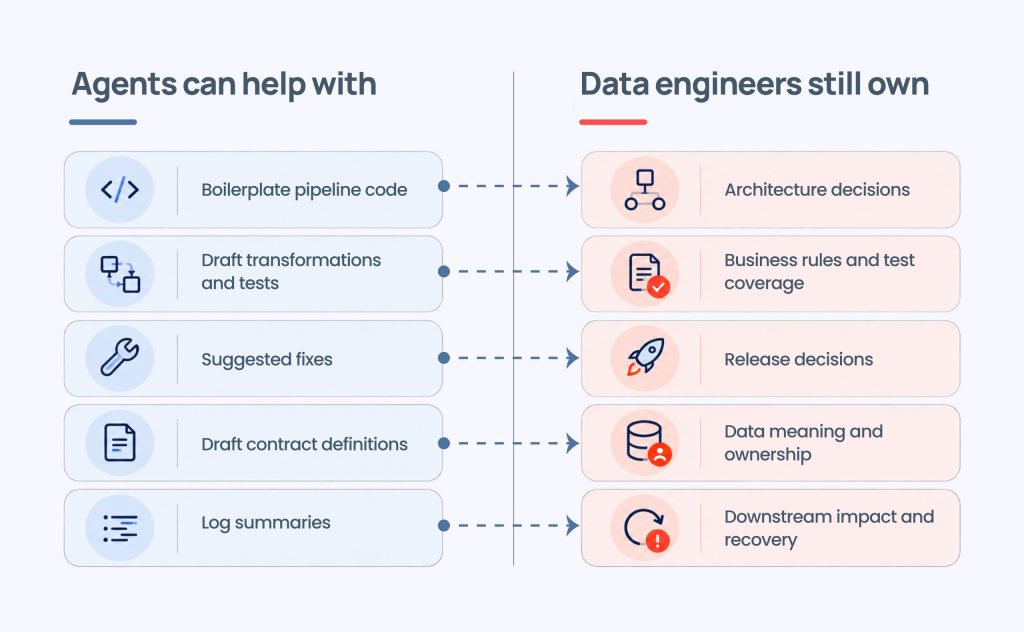
Agents can already help scaffold ingestion pipelines, write dbt models, generate tests, and suggest fixes for failing DAGs. The engineer is spending less time starting from scratch and more time deciding whether generated work is safe to use.
What changes when agents write the first draft?
In the Practical Data Community’s 2026 survey, around 86% of 423 data engineer respondents said AI helped them with writing code.
That means more connectors, transformations, and tests can begin with a generated draft. But the engineer still has to think beyond the first successful run.
What happens after a partial load, a retry, or when the same batch runs twice?
Apache Airflow best-practice guidance warns that repeated inserts during retries can create duplicate rows. A pipeline can complete successfully and still leave the data wrong.
That is the kind of issue an engineer still needs to spot. The Stack Overflow 2025 Developer Survey found that 66% of developers were frustrated by AI-generated solutions that were “almost right, but not quite.” Another 45% said debugging AI-generated code could take more time.
For data engineers, that is the risk!
Generated code can look fine while carrying a problem into production.
As more pipeline work gets generated, the engineer becomes less of the person writing every line and more of the person deciding what is ready to ship.
Where should the agent stop?
An agent investigating a failed DAG may need logs, table definitions, and sample data. It does not automatically need permission to delete production records or rebuild shared tables.
Those limits have to exist in the actual tools and permissions themselves. But access is only one boundary. The agent also needs clear rules for what the data is supposed to mean. If it is building an orders pipeline, does one row represent one order or one order line? Which field should be unique? When should the dataset arrive?
That is where data contracts become useful.
A simple contract can define that order_id must be unique, each row represents one order, and the data must arrive by an agreed time. The agent gets clearer rules to build against, and the engineer gets clearer rules to review against.
What still needs a data engineer?
SQL, Python, and system design still matter.
What becomes more valuable is the judgement around them: architecture decisions, test coverage, permissions, data contracts, and downstream impact.
Observability matters too. A pipeline may keep running while freshness changes, duplicates appear, or data starts behaving differently.
So, will AI agents replace data engineers? The work is moving in a different direction. Agents can take more of the repetitive pipeline work. Data engineers keep the architecture, the boundaries, and the judgment when something goes wrong.
By 2027, writing the pipeline may not be the hardest part.
Knowing whether to trust it may be.
Next in the series is The Analytics Engineer, the work of proving a data model can be trusted.