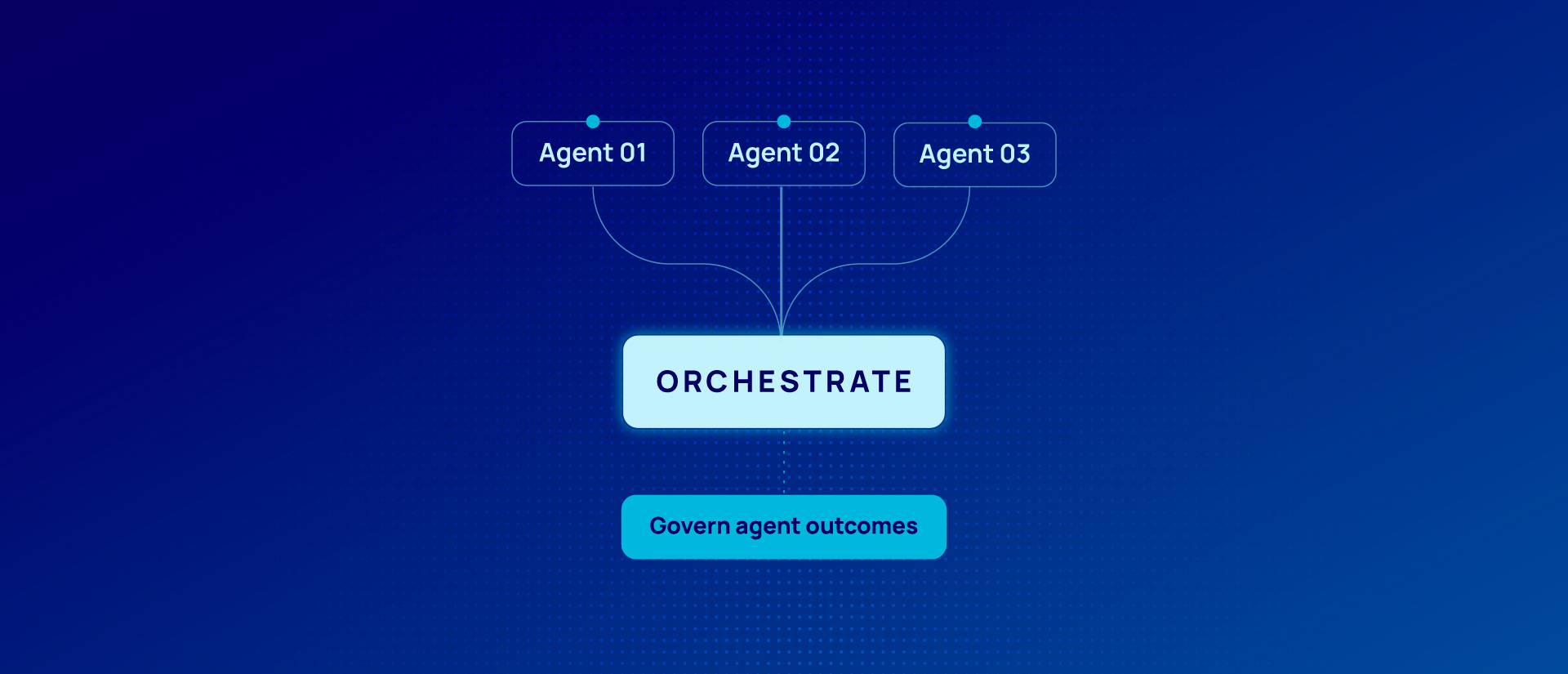
A fresh graduate finishes a portfolio project after weeks of work. The dataset is cleaned, the SQL is written, the dashboard is ready, and the findings are documented. It finally feels like something worth showing in an interview.
Then an AI agent does most of the same work in minutes. That creates a very reasonable question: was learning all of that a waste?
No. But what those skills prove is changing.
Starting a data career in the AI agent era means learning to direct, review and improve agent-generated work while building the judgment, business context and problem-solving evidence employers still need. The entry-level ladder is getting shorter, but the first step is not disappearing. It is changing.
How Is the Entry-Level Data Training Ground Changing?
For years, junior data work doubled as training. You learned SQL by writing a lot of SQL, understood messy datasets by cleaning them, and learned reporting by building the same kinds of reports again and again. You discovered bad joins, inconsistent definitions and missing values because sooner or later, somebody handed you work where all of those things existed.
AI is becoming good at exactly those first-pass tasks. Basic SQL, data cleanup, dashboard drafts, documentation and simple analysis can now be produced much faster than before. That does not mean every junior data role disappears, but it does mean companies need fewer hours of human effort to get to the first version of the work.
The pressure is already visible. A 2026 Stanford Digital Economy Lab study found that employment among workers aged 22 to 25 in highly AI-exposed occupations had fallen behind less-exposed peers, with the change driven more by lower hiring than by widespread layoffs. The distinction matters because the problem for someone entering data is not necessarily that the future job has vanished. It is that some of the tasks that used to provide the first few years of experience are now easier to automate.
The Ladder Is Getting Shorter, but the First Step Is Not Disappearing
The answer is not to compete with AI by doing the same repetitive task slightly faster. The better move is to understand the work well enough to operate one level above the first draft.
If an agent can write the SQL, the useful skill becomes knowing whether it used the correct grain. If it builds a dashboard, the question becomes whether the metric actually answers the business problem. If it cleans the dataset, someone still needs to understand what was removed, why it was removed, and whether that changed the result.
That is where the beginner role starts to shift. Instead of proving only that you can produce the work, you increasingly need to prove that you can direct it, review it and improve it.
From Producing the Work to Directing, Reviewing and Improving It
The beginner who stands out will not simply say, “I know how to use AI.” That will quickly become common.
The stronger signal is being able to work with AI without treating its first answer as final. That means giving the agent the right context, checking its assumptions, testing the output, making corrections and explaining why the final version is stronger than what came back first.
The old junior workflow was often about learning the task, doing it repeatedly, and becoming faster over time. The new workflow looks different. You still need to understand the task, but now you may use AI to accelerate the first pass and spend more time reviewing, validating and making sense of the result.
That is not a smaller job. It is a different training ground.
Do Basic Data Skills Still Matter if AI Can Draft the Work?
Yes. SQL, spreadsheets, BI tools, data modelling basics and enough Python to follow a workflow still matter because you cannot properly review work you do not understand.
AI being able to draft SQL does not make SQL irrelevant. It changes why you need to know it.
SQL, Spreadsheets and BI Still Get You Started
Imagine an agent produces a query with several joins and returns the expected revenue number. The query runs successfully, but that does not guarantee the result is correct.
One join may duplicate transactions. A filter may remove cancelled orders inconsistently. A customer-level table may have been joined to an order-level table without respecting the grain. The SQL can execute perfectly and still create the wrong business answer.
That is why fundamentals remain important. They allow you to inspect what AI produced rather than treating the output as a black box. The difference is that the value of the skill is moving away from only writing the query from scratch and toward being able to tell whether the query deserves to be trusted.
Judgment, Business Context and Checking the Output Get You Noticed
The stronger differentiator appears after the technical work is done.
Can you identify that Sales and Finance use different definitions of revenue? Can you see that a conversion decline may actually be caused by missing traffic data? Can you explain why a small data-quality issue changes the decision somebody would make?
These are harder skills to demonstrate through certificates alone. They become much clearer through the way you approach a real problem.
Employers are also placing more value on AI literacy alongside technical fundamentals. The point is not to replace data skills with AI skills. It is to combine the two, so you can use AI to move faster without losing the ability to challenge the result.
How Can Beginners Learn by Auditing Agent Output?
One of the most useful ways to learn data now may be to stop treating AI like an answer machine and start treating it like a junior teammate whose work you are responsible for reviewing.
Ask it to write the query, then inspect every assumption. Ask it to solve the same problem in two different ways and compare the result. Give it incomplete data and see what it misses. Change a metric definition and check whether the answer follows.
That turns AI-generated work into a learning environment rather than a shortcut.
AI CAN WRITE THE FIRST DRAFT. YOUR CAREER STARTS WITH WHAT YOU DO NEXT.
Review it. Break it. Question it. Improve it. Explain it.
Review Assumptions, Compare Approaches and Test Edge Cases
Suppose an agent tells you ecommerce revenue fell because conversion declined. A weak portfolio stops there and turns the answer into a chart.
A stronger one asks what else might explain the result. Did traffic fall? Were cancelled orders included? Did a promotion end during the period? Were duplicate transactions present in the comparison month? Was one region missing data?
Maybe the original answer survives every check. That is useful because now you have shown that you can validate the result rather than simply repeat it.
Maybe it does not survive. That may be even more valuable for a portfolio, because you can show what was wrong, how you found it and how the conclusion changed.
When the Wrong Answer Comes From the Data, Not the Agent
There is another habit beginners need to learn early: not every bad AI answer is actually an AI problem.
Sometimes the agent writes a perfectly reasonable query against unreliable data. A source field may be stale, a pipeline may have duplicated records, a day of transactions may be missing, or a definition may have changed upstream without the analysis knowing.
That is where data observability and root-cause thinking become useful. At Qualdo, this is the kind of problem we work on from the data side: tracing issues across data, pipelines, models and business KPIs to understand where a wrong result actually started.
For someone beginning a data career, the takeaway is simple. Do not stop at asking whether the agent made a mistake. Check whether the data underneath it was reliable enough to produce the right answer in the first place.
Question the agent, then question the data feeding the agent.
How Should You Build a Data Portfolio With AI in 2026?
A strong portfolio in 2026 should show how you think, not hide how the first draft was produced.
Ten polished dashboards that all follow the same tutorial format may tell an employer less than one project where you clearly show the business problem, the first answer, what you challenged, what you corrected and why you trust the final result.
The work itself does not need to be complicated. The reasoning should not be invisible.
Show the Agent’s First Answer and How You Tested It
Take a simple portfolio question: why did ecommerce revenue fall last month?
You give the dataset to an agent, it analyzes the numbers and tells you conversion declined. Instead of cleaning that answer up and presenting it as your own conclusion, keep it as the starting point.
Then show what you checked. Look at traffic, cancelled and refunded orders, promotion periods, duplicate transactions and missing regional data. Explain which checks changed the result and which ones did not.
If the answer survives those checks, you have shown that you know how to validate it. If it fails, you have shown something even more useful: that you know how to challenge a plausible answer and find the real issue.
One Good Project Can Say More Than Ten Dashboards
A strong portfolio might include the agent’s original SQL, your corrected version, the reason for the change, the metric definition you used, the validation steps you ran and the final conclusion you would be comfortable presenting to a business team.
That tells an employer much more than a screenshot of a finished dashboard. It shows judgment, and judgment is much harder to automate than the final formatting of a chart.
How Can Career Switchers Enter Data Roles With AI?
Career switchers may have an advantage that is easy to overlook: they already understand something about how a business actually works.
Someone moving from retail operations may understand stock availability and replenishment better than a technically stronger beginner. Someone from finance may immediately question how revenue is recognized. A marketer may understand campaign attribution and customer acquisition definitions in a way that a generalist analyst does not.
AI can help those people reach the technical first draft faster. Their domain knowledge helps them know when the draft does not make sense.
Domain Knowledge Becomes More Valuable When AI Drafts the Technical Work
This changes the usual advice given to career switchers.
You do not necessarily need to erase your previous career and start again as a completely blank “data person.” Bring the useful part with you.
If you spent five years in retail, build a retail data project. If you worked in marketing, analyze campaign data. If you come from finance, choose a problem where business definitions matter.
Your previous experience can become the context AI does not have. That can be a stronger entry point than trying to compete only on who has completed the most technical courses.
Which Companies and Roles Should Beginners Target?
Do not search only for “Junior Data Analyst.”
Look at what the team is actually doing.
Companies deploying AI agents, copilots, modern data platforms, semantic layers and observability systems still need people around those systems. They need people who can validate outputs, document edge cases, check data, handle exceptions, review workflows and provide business context.
Those responsibilities may sit inside analytics, data operations, data quality, product analytics, AI operations or another title entirely. The opportunity is becoming more distributed across the stack, which means beginners may need to look beyond the job titles that defined entry-level data work a few years ago.
What a Strong Beginner Profile Looks Like in 2026
The strongest profile is no longer built around proving you can perform every repetitive task manually. It shows that you understand the work well enough to supervise, challenge and improve it.
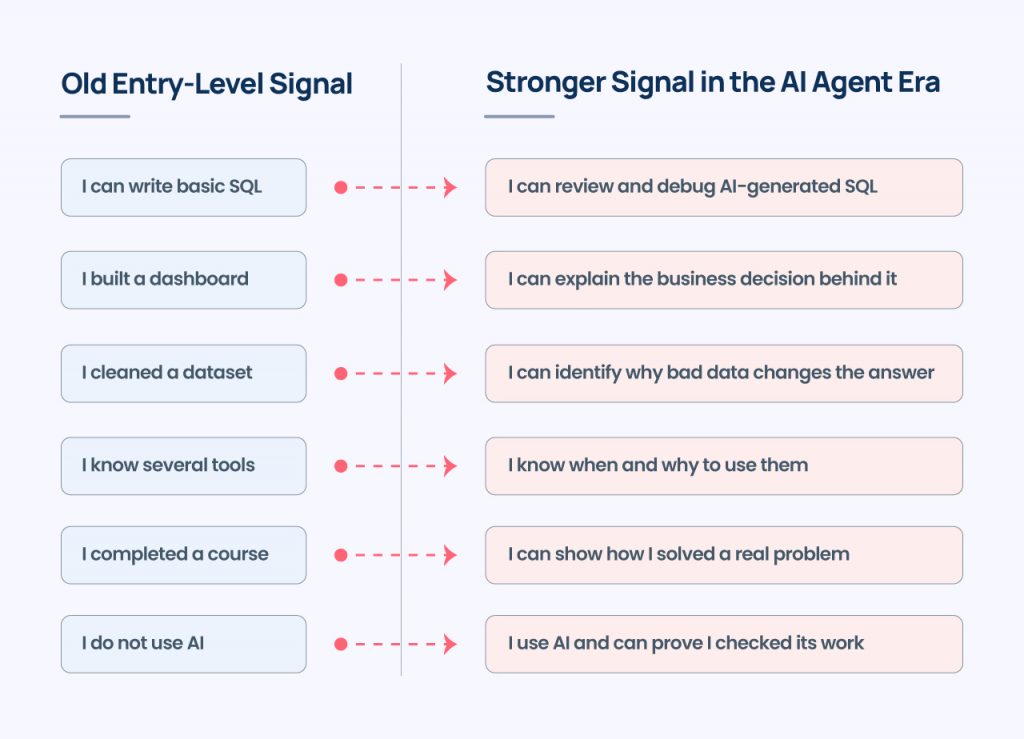
None of this makes technical skills less important. It changes where those skills sit in the workflow.
SQL helps you review SQL. Data modelling helps you understand whether the agent used the correct structure. Data-quality knowledge helps you challenge the input. Business context helps you challenge the conclusion. Communication helps you explain why any of it matters.
What the Career Switcher or Fresh Graduate Looks Like in 2027
The strongest beginner may not be the person who can manually complete the largest number of junior tasks.
It may be the person who can reach a first draft quickly, understand what was generated, identify where it fails, correct it and connect the result to a real business problem. That is a different entry-level employee, but it is still an entry point. The training ground did not disappear. It moved.
FAQs
Is data analytics still a good career in 2026?
Data analytics remains a viable career, but the way people enter it is changing. Employers still need people who can frame questions, validate results and explain what a number means for the business. Basic reporting is easier to automate, so judgment, context and the ability to work effectively with AI matter more.
Will AI replace entry-level data jobs?
AI is taking over more repetitive junior work such as basic SQL, cleanup, first-pass reporting and simple dashboard creation. That creates pressure on traditional entry-level roles, but it does not remove the need for beginners who can review outputs, validate data and provide business context.
How can a fresher get a data job with no experience?
Build evidence of how you solve problems. Use a public dataset, ask a real business question, let AI help with the first draft, and document what you checked, corrected and learned. Showing your reasoning and validation process is more useful than presenting only a polished final dashboard.
What data skills should beginners learn in the AI era?
Keep the fundamentals: SQL, spreadsheets, data modelling basics, BI tools and enough Python to understand a workflow. Add validation, business metrics, problem framing, data quality, AI-assisted analysis and communication. The goal is to understand the work well enough to review AI-generated output rather than simply accept it.
Is SQL still worth learning in 2026?
Yes. AI can draft SQL quickly, but you cannot properly review a query you do not understand. SQL knowledge helps you catch bad joins, incorrect grain, missing filters and logic that quietly changes the answer.
Should beginners use AI in portfolio projects?
Yes, but show how you used it. Include the first output, the assumptions you checked, the mistakes you found and the final version you would defend. Treat AI as part of the workflow rather than something to hide or something whose output you automatically trust.
How can career switchers enter data roles with AI?
Use the domain knowledge you already have. Someone from retail, marketing, finance, supply chain or another field may understand the business problem better than a beginner with more technical tools. Use AI to accelerate the technical work, then demonstrate where your domain knowledge improves the answer.
What should a data portfolio look like in 2026?
A strong portfolio should show a business question, the first analysis, your validation process, corrections and a conclusion you can defend. One carefully documented project that shows judgment, data-quality checks and business reasoning can communicate more than several basic dashboards built from tutorials.
Which entry-level data jobs are most affected by AI?
Roles dominated by repetitive production work such as routine cleanup, simple SQL, first-pass dashboards and basic reporting are more exposed. Roles that combine analysis with validation, data quality, business context, monitoring and exception handling offer beginners more room to contribute alongside AI.
Key Takeaway
There was a time when the easiest way to prove you were ready for a data job was to show that you could do the basic work.
That bar is changing because AI can already produce much of the first draft. What becomes more valuable is what happens after it does. Can you tell whether the answer is right? Can you find the assumption that broke it? Can you explain why the corrected answer matters?
The old entry-level advantage was, “I can do the basic work.” The new one may be, “I can tell when the basic work is wrong.” That is where the first three years of a data career start getting rebuilt.
That’s a wrap on our series! The data landscape is evolving, and so are the skills needed to succeed. Keep learning, experimenting and building for what’s next.