
1. Why Are Data Quality Tools the Real Accelerator for Data Science Workflows?
Tired of explaining bottlenecks that come from “the data?” That’s the daily reality for data science, engineering, and analytics leaders managing modern data stacks. In 2025, high-performing teams have shifted, and data quality tools are embedded into every stage of the workflow, enabling not just clean data, but efficient processes and accurate results.
As per Gartner’s 2025 Data & AI Trends, yet 57% of organizations yet cite unexpected quality issues as the primary reason why analytics projects stall or underperform.
2. What Do Data Quality Tools Actually Do in 2025?
Breaking down the role of modern tools beyond simple cleansing.
2.1 Overview for Analysts and Decision-Makers
Data quality tools in 2025 go beyond cleaning; they now automate, monitor, and optimize across your entire data science lifecycle.
2.2 Core Capabilities
Highlighting what decision-makers need to know at a glance.
Profiling
To begin with, profiling instantly scans data streams for anomalies before they affect models.
Standardization
In addition, standardization identifies duplicates, missing values, and mismatches to support everything from reporting to ML and Agentic AI.
Automated Validation
Furthermore, automated validation utilizes statistical and rule-based checks at scale to flag errors in real-time.
Monitoring and Observability
Moreover, dashboards, alerts, and end-to-end lineage support fast troubleshooting and compliance tracking.
Seamless Integration
Notably, seamless integration ensures compatibility across BI, ETL, ML, and cloud platforms.
AI-Driven Features
Lastly, embedded AI helps visualize, adapt, and automatically remediate issues, making workflows proactive rather than reactive.
According to a leading analyst, enterprises with automated data quality reduce repetitive tasks by up to 40% and report fewer unexpected analytics failures.
3. Where Do Data Quality Tools Fit into Data Science Workflows?
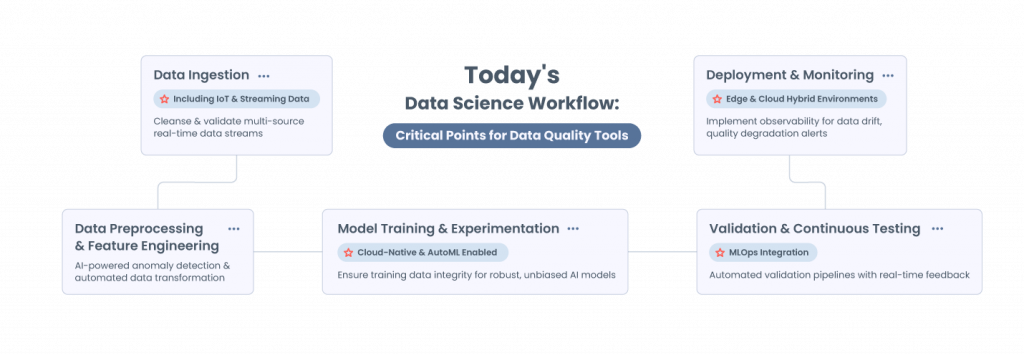
Today’s data workflows are non-linear, collaborative, and always evolving. Therefore, data quality tools help prevent waste, reduce risk, and boost model confidence at every step.
3.1 Key Workflow Stages
Mapping the touchpoints where tools add the most value.
1. Data Ingestion
To start, cleanse and validate IoT, API, and cloud streams in real time.
2. Preprocessing & Feature Engineering
Next, detect anomalies early and transform data reliably using AI.
3. Model Training & Experimentation
Then, ensure consistent, bias-free training datasets.
4. Validation & MLOps Testing
Afterward, automated validation pipelines provide fast feedback loops.
5. Deployment & Monitoring
Finally, prevent model drift and late-night surprises with real-time alerts.
4. What Should Modern Data Quality Tools Offer?
In 2025, teams demand more than scripts; they require enterprise-grade capabilities that scale and integrate.
4.1 Features That Matter
Listing enterprise-grade must-haves for 2025-ready platforms.
- AI-powered profiling and anomaly detection
- Batch and streaming cleansing
- Real-time monitoring and alerting
- Rule-based validations with industry-specific flexibility
- Shared dashboards for business and tech alignment
- Full data lineage with root cause analysis
- Open integrations (cloud, on-prem, hybrid)
- Deployment options include cloud-native, open-source, and enterprise
In Gartner Magic Quadrant 2025 – the report recommends platforms with cloud/hybrid support and built-in automation for better model reliability and operational efficiency.
5. What Benefits Should Data Teams Expect?
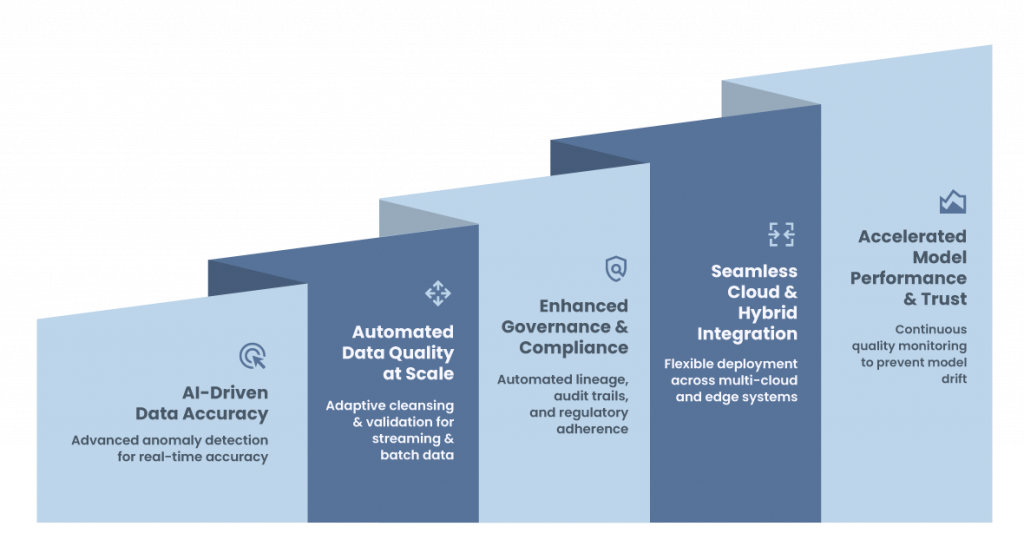
Data quality tools today do more than reduce errors; in fact, they accelerate delivery, enable governance, and increase trust.
5.1 Key Outcomes
Turning capabilities into real, measurable improvements.
Data Accuracy on Autopilot
To begin, machine learning identifies issues automatically, thereby reducing the need for manual checks.
Scale Without Sacrificing Quality
Similarly, cleansing and validation occur across SQL warehouses, data lakes, and data streams.
Frictionless Governance & Compliance
Meanwhile, track every data transformation and simplify audits.
Cloud & Hybrid Flexibility
In addition, apply quality controls wherever your data resides.
Stronger Model Performance
Finally, continuous monitoring keeps models aligned with data reality.
6. Real-World Scenarios: How Do These Tools Solve Workflow Pains?
Each sector reveals unique but solvable quality challenges.
6.1 Examples by Industry
Each sector reveals unique but solvable quality challenges.
Finance
To illustrate, continuous transaction validation eliminates reporting errors and slashes audit prep time.
Healthcare
Similarly, cleansing diverse datasets improves the accuracy of predictive care models.
E-Commerce/Marketing
In another example, real-time monitoring ensures ad spend decisions are based on clean, timely data.
Cross-Industry
In general, Everest Group reports up to 21% higher satisfaction in analytics teams with integrated quality tools.
7. How to Choose the Right Data Quality Tool?
Selection depends on context, compatibility, and scale.
7.1 Key Questions to Ask
- Can it integrate with our BI/ETL/ML stack?
- Does it support real-time and automated validation?
- Is it compatible with cloud, on-prem, and hybrid environments?
- Is it usable by both technical and business users?
- Can rules be scaled or adjusted quickly and efficiently?
- Are security, compliance, and auditing features built-in?
As highlighted in Forrester Wave 2025, tools with seamless integration and low-code UIs reduce onboarding by great extent and improve business adoption.
8. Implementation Best Practices for High-Efficiency Data Quality
Efficiency isn’t about installing a tool – rather, it’s about building quality into your processes.
8.1 Steps to Get Started
Practical steps help teams embed quality into their DNA.
1. Audit Workflow Bottlenecks
First, identify where quality issues cause delays or rework.
2. Map Features to Workflow Stages
Don’t wait till the end – instead, start with ingestion and continue through deployment.
3. Train Teams & Assign KPIs
Next, make quality a shared goal, not an IT-only responsibility.
4. Create Feedback Loops
Finally, utilize alerts, dashboards, and post-mortems to continually improve.
9. Data Quality Tools from Cleanup to AI Edge
The data-driven enterprise of 2025 is fast, distributed, and complex. Without quality, even the best analytics fail. Fortunately, modern data quality tools offer always-on assurance, turning raw input into trusted outcomes.
With AI, automation, and observability now table stakes, it’s time to move from rework and firefighting to trusted delivery and continuous improvement.
For organizations ready to streamline workflows and enhance trust, explore how Qualdo-DRX empowers teams to automate, monitor, and optimize data quality across all data sources.